
名词解释——POJO
名词解释——POJO
本文译自< https://www.geeksforgeeks.org/pojo-vs-java-beans/>,主要讲解 POJO 的特点与用处,并与 Java Bean 进行对比。@qiuchi
什么是POJO
POJO 全称是 Plain Old Java Object。
它是一个普通的 Java 对象,不受任何特殊限制的约束,只受 Java 语言规范的约束,不需要任何类路径( not requiring any classpath,秋迟感觉意思应该是不需要依赖其它类)。POJO 用于提高程序的可读性和可重用性。POJO 获得了最多的接受,因为它们易于编写和理解。它们是在 EJB 3.0 中由 Sun microsystems 引入的。
POJO不应:
继承预先指定的类
例如:public class GFG extends javax.servlet.http.HttpServlet { … } 不是 POJO 类。
实现预先指定的接口
例如:public class Bar implements javax.ejb.EntityBean { … } 不是 POJO 类。
这一点跟后面的
实现 Serializable 接口相悖,姑且认为这一点不包括Serializable接口吧。@qiuchi
包含预先指定的注解
例如:@javax.persistence.Entity public class Baz { … }不是 POJO 类。
POJO定义了一个实体。如果您想要一个Employee类,那么您可以创建一个POJO,如下所示:
// Employee POJO class to represent entity Employee
public class Employee
{
	// default field
	String name;

	// public field
	public String id;

	// private salary
	private double salary;

	//arg-constructor to initialize fields
	public Employee(String name, String id,
							double salary)
	{
		this.name = name;
		this.id = id;
		this.salary = salary;
	}

	// getter method for name
	public String getName()
	{
		return name;
	}

	// getter method for id
	public String getId()
	{
		return id;
	}

	// getter method for salary
	public Double getSalary()
	{
		return salary;
	}
}
上面的示例是 POJO 类的一个定义良好的示例。如您所见,
- 对字段的访问修饰符(access-modifiers)没有限制。它们可以是私有的、默认的、受保护的或公有的(private, default, protected, or public)。
- 另外,类中可以不包含任何构造函数。
POJO 是一个封装了业务逻辑的对象(an object which encapsulates Business Logic)。下图显示了 POJO 类的工作示例。控制器与业务逻辑交互,业务逻辑又与 POJO 交互以访问数据库。在此示例中,数据库实体由 POJO 表示。这个 POJO 具有与数据库实体相同的成员。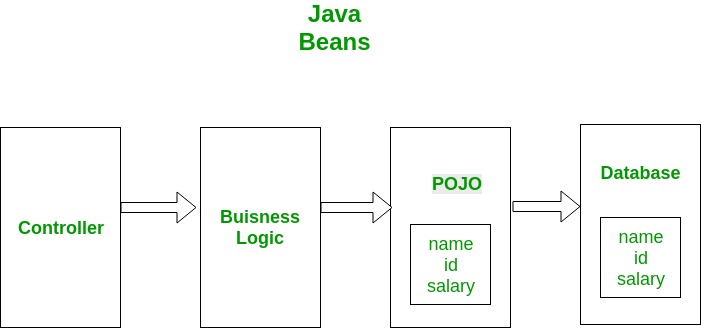
什么是Java Beans
Bean 是特殊类型的POJO,POJO 成为一种Bean是有一些条件的:
所有的 JavaBean 都是 POJO,但并非所有的 POJO 都是 JavaBean。
Serializable,Bean 应该实现 Serializable 接口。(一些没有实现 Serializer 接口的 POJO 仍被称为 POJO。)
这里原文是:
Serializable i.e. they should implement Serializable interface. Still, some POJOs who don’t implement a Serializable interface are called POJOs because Serializable is a marker interface and therefore not of many burdens.
字段应该是私有的。这是为了提供对字段的完全控制。
字段应该有 getter 或 setter,或者两者都有。
Bean 中应该有一个 无参(no-arg)构造函数。
字段只能由构造函数或 getter 设置器访问。
Getter 和 Setter 根据字段名,有特殊的命名规则。例如,如果字段名是 someProperty,那么它的 getter 最好是:
public "returnType" getSomeProperty()
{
   return someProperty;
}
而setter 方法如下:
public void setSomePRoperty(someProperty)
{
   this.someProperty=someProperty;
}
Getter 和 Setter 方法通常可见性设为 public。Getter 和 Setter 提供了对字段的完全限制。例如考虑下面的属性:
Integer age;如果你把 age 的可见性设置为 public,(如 public Integer age)那么任何对象都可以直接访问。假设你想让 age 不能为0,在这种情况下,你就无法控制了。任何对象都可以将其设置为 0 。但是通过使用 setter 方法,你就可以控制。你可以在 setter 方法中设置一个条件。同样,对于 getter 方法,如果你希望你的年龄是 0,那么它应该返回 null,你可以通过使用 getter 方法来实现,如下所示:
// Java program to illustrate JavaBeans
class Bean
{
	// private field property
	private Integer property;
	Bean()
	{
		// No-arg constructor
	}

	// setter method for property
	public void setProperty(Integer property)
	{
		if (property == 0)
		{
			// if property is 0 return
			return;
		}
		this.property=property;
	}

	// getter method for property
	public Integer getProperty()
	{
		if (property == 0)
		{
			// if property is 0 return null
			return null;
		}
		return property;
	}
}

// Class to test above bean
public class GFG
{
	public static void main(String[] args)
	{
		Bean bean = new Bean();

		bean.setProperty(0);
		System.out.println("After setting to 0: " +
								bean.getProperty());

		bean.setProperty(5);
		System.out.println("After setting to valid" +
					" value: " + bean.getProperty());
	}
}
Output:-
After setting to 0: null
After setting to valid value: 5
POJO vs Java Bean
POJO | Java Bean |
|---|---|
| It doesn’t have special restrictions other than those forced by Java language.(只被Java语言限制) | It is a special POJO which have some restrictions.(特殊的POJO) |
| It doesn’t provide much control on members.(对成员变量的控制性不强) | It provides complete control on members.(完全控制成员变量(只能通过getter或者setter或者构造函数访问)) |
| It can implement Serializable interface.(可以序列化,不必须) | It should implement serializable interface.(应该序列化) |
| Fields can be accessed by their names. | Fields are accessed only by getters and setters. |
| Fields can have any visibility. | Fields have only private visibility. |
| There may/may-not be a no-arg constructor. | It must have a no-arg constructor.(必须有无参构造函数) |
| It is used when you don’t want to give restriction on your members and give user complete access of your entity | It is used when you want to provide user your entity but only some part of your entity. |
总结
POJO 类和 Bean 都用于定义 java 对象,以增加其可读性和可重用性。POJO 没有其他限制,而 Bean 是带有一些限制的特殊 POJO。